Lung nodules are common findings on chest imaging, and while most are not cancer, proper follow-up helps determine which ones need further evaluation. Interventional pulmonologist Anthony Lanfranco, MD, discusses what causes them and when action is needed.
A routine scan for something else, such as a lingering cough or a fall, can turn up an unexpected line in a patient’s results that reads “pulmonary nodule.” For many people, those two words are enough to cause real worry.
A lung nodule is a small, round or oval spot in the lung that shows up on a chest X-ray or CT scan. Most lung nodules are not cancerous, but determining which ones need a closer look is what makes follow-up so important.
“Finding a lung nodule is far more common than people realize, and it does not mean they have lung cancer,” says Anthony Lanfranco, MD, an interventional pulmonologist at CU Medicine Interventional Pulmonology – Highlands Ranch Pavilion 1. “If I were to do a CT scan of 100 people off of a random street, about 20-30 people would have a lung nodule.”
What is a Lung Nodule?
A lung nodule is a small and usually round or oval growth of tissue in the lung. On imaging, it often looks like a white spot against the darker background of the lung.
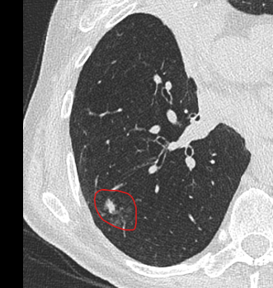
When evaluating lung nodules, doctors look at the size, shape, edges and density. Depending on what the initial CT scan shows, specialists like Dr. Lanfranco make a plan tailored to each patient’s unique nodule. Specialists also look to see if the nodule has changed over time.
Are Lung Nodules Cancer?
In most cases, no. The majority of lung nodules are benign, which means they are not cancer. Many benign nodules are the lasting mark of something the body already dealt with.
“Every time we breathe, we breathe in stuff like inorganic materials, dust, mold spores or bacteria,” said Dr. Lanfranco. “Our bodies are good at clearing that stuff out. However, sometimes the debris makes their way into the lung, and our immune system reacts by encircling it with immune cells.”
Additionally, some nodules are fungal infections and noncancerous growths.
A small percentage of lung nodules are cancerous. Interventional pulmonologists are trained to identify, test and coordinate care when suspicious lung nodules appear.
What Causes Lung Nodules?
Lung nodules can form for many reasons, and most have nothing to do with cancer.
Common causes include the following.
- Past infections - Bacterial, fungal or other lung infections can leave small areas of healed tissue behind.
- Inflammation - Conditions that cause swelling or irritation in the lungs can lead to nodules.
- Scarring - Injury or illness can leave scar tissue that shows up as a spot on a scan.
- Smoking related changes -Long term smoking can cause changes in lung tissue and raises the risk that a nodule is cancer.
- Tumors - Nodules can be noncancerous tumors or early cancer
“In Colorado, we have to worry about radon,” said Dr. Lanfranco. “Making sure your home has a radon mitigation system is key to avoiding lung cancer in a house with naturally occurring radon coming up from the ground.”
Do Lung Nodules Need to Be Biopsied?
Doctors decide based on how likely a nodule is to be cancer. Low-risk nodules are usually monitored with repeat CT scans at set intervals, an approach known as watchful waiting, while more concerning nodules may require a biopsy.
Factors for lung nodule biopsy:
- Size - Smaller nodules are less likely to be cancer than larger ones.
- Shape and edges - Smooth, round nodules tend to be less worrisome than those with irregular edges.
- Appearance on the scan - Solid, hazy and partly solid nodules are each handled differently.
- Growth over time - A nodule that stays the same size is less likely to be cancer than one that grows.
- Patient history - Age, smoking history and family history of lung cancer all factor in.
Biopsy options for lung nodules:
Navigational or robotic bronchoscopy - A thin tube with a camera is guided through the airways to reach the nodule, with computer mapping or robotic assistance helping pinpoint its location.
Endobronchial ultrasound, or EBUS - An ultrasound on the bronchoscope allows doctors to sample nearby lymph nodes.
CT guided needle biopsy - Using CT images as a guide, a doctor passes a thin needle through the chest wall to collect a sample.
“Robotic bronchoscopy is my preferred method for biopsy,” said Dr. Lanfranco. “It’s very low risk for complications and we can safely take images and samples of the nodule and nearby lymph nodes.”
Schedule with CU Medicine Interventional Pulmonology – Highlands Ranch Pavilion 1
Patients with a lung nodule or another lung or airway condition can see the interventional pulmonology team at CU Medicine Interventional Pulmonology – Highlands Ranch Pavilion 1. Interventional pulmonologists use minimally invasive techniques to diagnose and treat conditions inside the chest, often without open surgery. In addition to evaluating lung nodules, the team cares for patients with lung cancer, airway disorders, pleural diseases and advanced emphysema. Call 720-213-4501 to schedule an appointment with Dr. Anthony Lanfranco and his team.
Wondering whether lung cancer screening is right for you? Read our guide to lung cancer signs, symptoms and treatment to find out more.